Follow sunlight from a focused beam to steam, spinning turbines, and electricity—and learn why mirrors, heat storage, weather, and cost shape real solar power plants.
A small focus, a powerful idea
Sunlight spreads energy across a wide area. A magnifying glass can bend some of that light toward a small spot. A surface there can become hot because more energy reaches each bit of it. The lens gathers energy; it does not create extra energy. This is the basic idea behind focusing light with a lens.
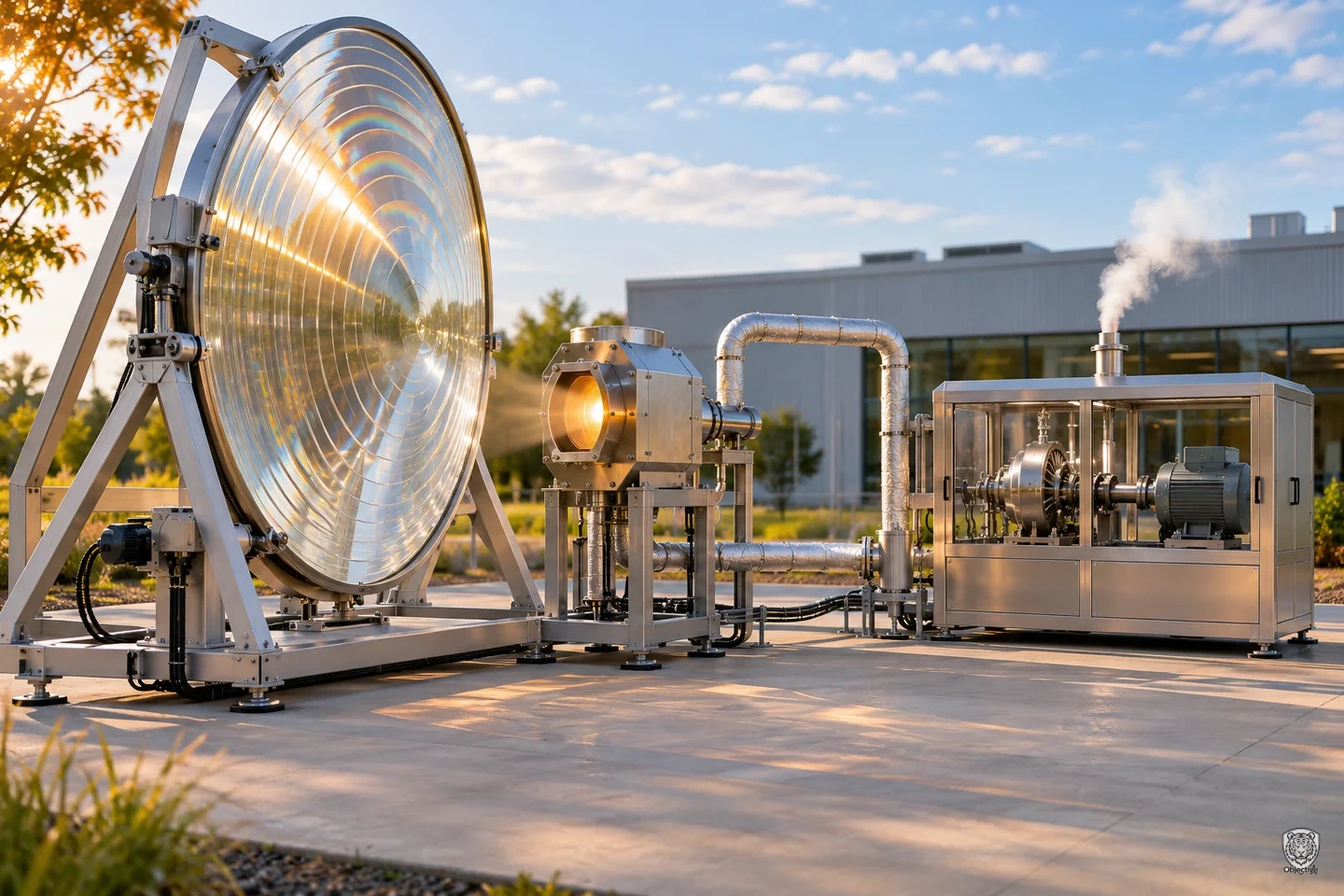
Now imagine collecting sunlight across a much larger area and using the heat to make steam. That steam can help generate electricity. Commercial plants usually use fields of mirrors for this job. The approach is called concentrating solar-thermal power, or CSP. The lens system in our illustration is a concept, not a photograph of a working power plant.
Never look at the Sun through a lens. Focused sunlight can damage eyes or start fires. Pressurized steam also needs professional controls. These systems belong in supervised research or engineered facilities.
Two paths from sunshine
Most familiar solar panels use photovoltaic cells, often shortened to PV. These cells contain special materials called semiconductors. When light reaches them, they produce an electric current. PV converts sunlight directly into electricity, without first making steam.
CSP follows a different path: sunlight becomes heat, heat drives machinery, and machinery powers a generator. Both methods use solar energy, but their equipment and storage needs differ. A PV system can pair with batteries. A CSP plant can store heat before making electricity.
Solar heat can also do useful work without a generator. Factories may use it for processes that need high temperatures. The Department of Energy describes both power and industrial heat uses.
Mirrors follow the Sun
A power tower has many mirrors aimed toward a receiver near its top. Each mirror, called a heliostat, moves as the Sun crosses the sky. That movement keeps reflected light on the target. The receiver absorbs the light and transfers its energy into a fluid.
Another design uses long, curved mirrors shaped like troughs. They focus light along receiver tubes rather than toward one tower. In many trough plants, oil inside those tubes carries heat to other equipment. Argonne National Laboratory explains these mirror arrangements.
The receiver is the link between light and the rest of the plant. Collecting bright light is only the first task. Engineers must also move the heat where it is needed while limiting losses.
A field gathers light over much more space than one small lens. This explains why a hot focal spot does not prove a device can power a home. Temperature and the total amount of useful energy are different measurements.
Heat turns a turbine
In a common steam-based design, the hot fluid passes through a heat exchanger. This device lets heat cross between separate fluid systems. In the steam generator, that heat turns water into steam. The heat-carrying fluid and the water do not have to mix.
High-pressure steam expands through a turbine, pushing blades attached to a shaft. The shaft turns an electrical generator. Inside the generator, motion between magnetic fields and wire coils produces electric current. The turbine supplies motion; the generator converts that motion into electricity.
After leaving the turbine, steam enters a condenser. There it loses heat and becomes liquid water again. A pump returns that water for another trip through the system. The U.S. Geological Survey describes this repeating steam cycle.
Recycling the steam water does not remove every water need. Cooling may require another water supply. Dry cooling uses air instead, reducing water use but often adding cost and reducing performance.
Keeping heat after sunset
Some CSP plants store energy in molten salt: salt kept hot enough to remain liquid. A common arrangement has a cooler tank and a hotter tank. Heated salt enters the hot tank until the plant needs its energy.
Later, the salt releases heat through an exchanger to make steam. It returns to the cooler tank afterward. What waits in storage is heat, not electricity. The turbine and generator still have work to do.
Designs vary. Some use the same fluid to collect and store heat. Others use separate fluids with another heat exchanger between them. DOE's storage guide explains both arrangements. A solar plant therefore does not always boil water directly in its receiver.
Storage can support generation after sunset or during clouds. Its supply is finite, depending on stored energy and how quickly the plant uses it.
For example, operators might save some afternoon heat for an evening period when homes need power. That choice shifts when electricity is produced. It cannot provide an endless supply through a long run of cloudy days.
Weather and efficiency matter
CSP needs strong direct sunlight that its mirrors can focus. Clouds scatter and block that light. A bright-looking sky may still provide little useful direct beam. DOE distinguishes direct and scattered sunlight, while NREL's solar guide explains CSP's reliance on the direct beam.
No plant turns all arriving solar energy into useful electricity. Some light misses the receiver. Some heat escapes, and the steam cycle must release heat during cooling. Pumps and other equipment also use energy. A hotter receiver alone therefore does not prove that a complete plant will perform better.
Engineers assess the whole system together. Useful comparisons consider electricity delivered over time, including cloudy periods and maintenance, rather than just the brightest moment at noon.
Choosing a useful role
Cost matters alongside performance. IRENA's report on projects completed in 2025 found lower average electricity costs for solar PV than CSP. However, a plant's ability to supply energy after sunset also has value. Storage, local sunlight, construction, and operating costs affect the choice.
This suggests a fair comparison should match the service needed. Supplying daytime electricity and supplying electricity through the night are different tasks. Planners can compare CSP with storage against PV paired with batteries or other sources.
Every renewable technology also has a life cycle. Mining materials, making equipment, building plants, and eventually recycling or disposing of parts create impacts. NREL's life-cycle review finds that renewable electricity generally causes fewer greenhouse gas emissions than fossil-fuel electricity, but those emissions are not zero.
Focused sunlight offers a useful route from heat to power. Its success depends on how well the full plant fits its location and the electricity people need.