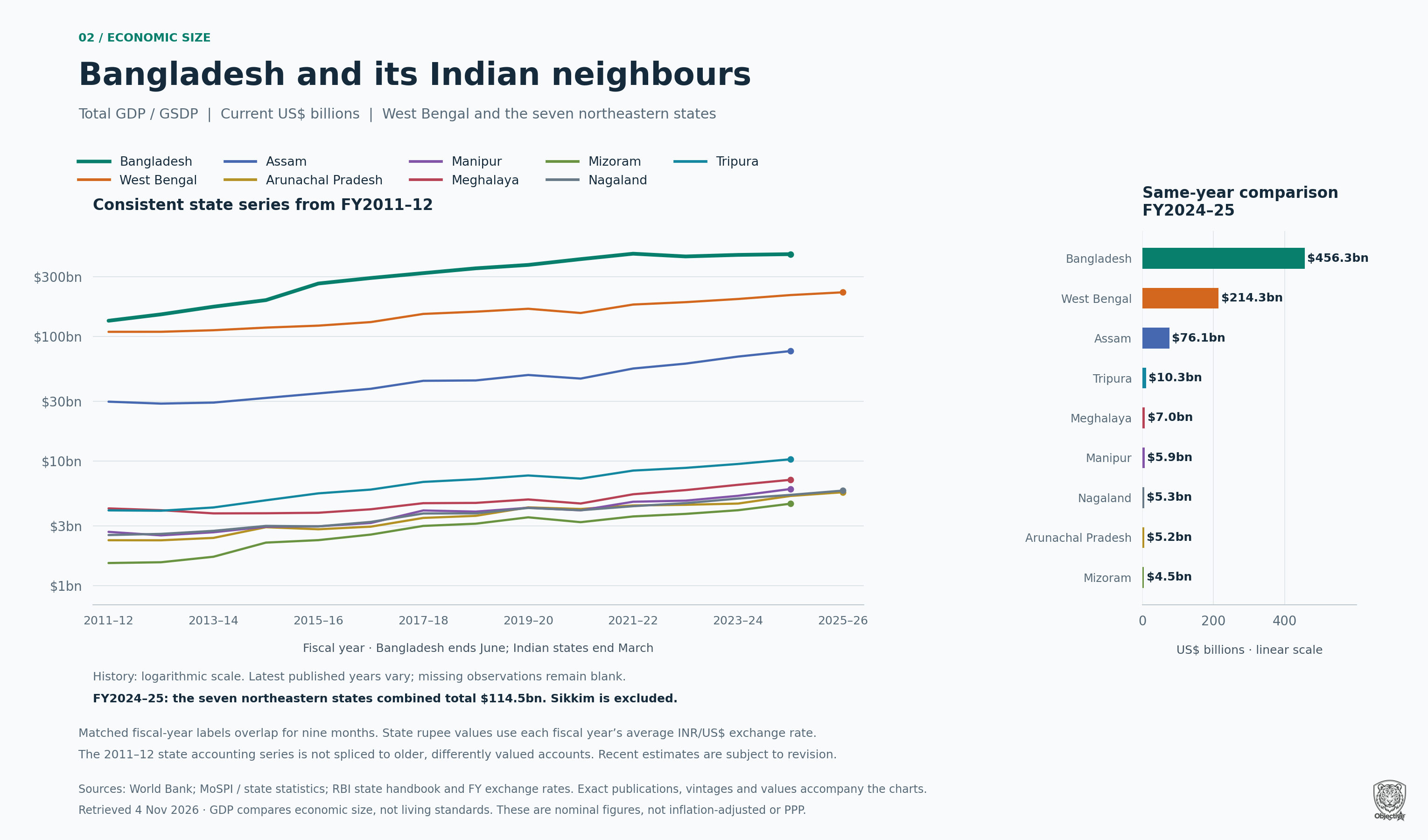
Bangladesh has become an economic force in eastern South Asia. Its economy is larger than West Bengal’s and the seven northeastern Indian states combined, according to a comparison of official figures for 2024–25. That scale gives Bangladesh an important position as a market, a producer, and a transport partner. Its coastline adds another advantage: access to the Bay of Bengal can shorten some of the Northeast’s long journeys to international shipping routes.
The numbers show the difference. Bangladesh’s gross domestic product, or GDP, was about $456.3 billion. West Bengal’s gross state domestic product was about $214.3 billion. The Seven Sisters—Assam, Arunachal Pradesh, Manipur, Meghalaya, Mizoram, Nagaland, and Tripura—together produced about $114.5 billion. Adding West Bengal brings their combined output to approximately $328.8 billion. Bangladesh was therefore about $127.5 billion, or 39 percent, ahead of these eight states together.
What is GDP (Gross Domestic Product)?
GDP is the measure of the value of goods and services produced within an economy. This comparison uses current prices, with Indian state figures converted into dollars using the financial year’s average exchange rate. Bangladesh’s financial year runs from July to June, while India’s runs from April to March. The periods overlap for nine months, making the comparison useful but imperfect. The figures may also change as governments revise their estimates.
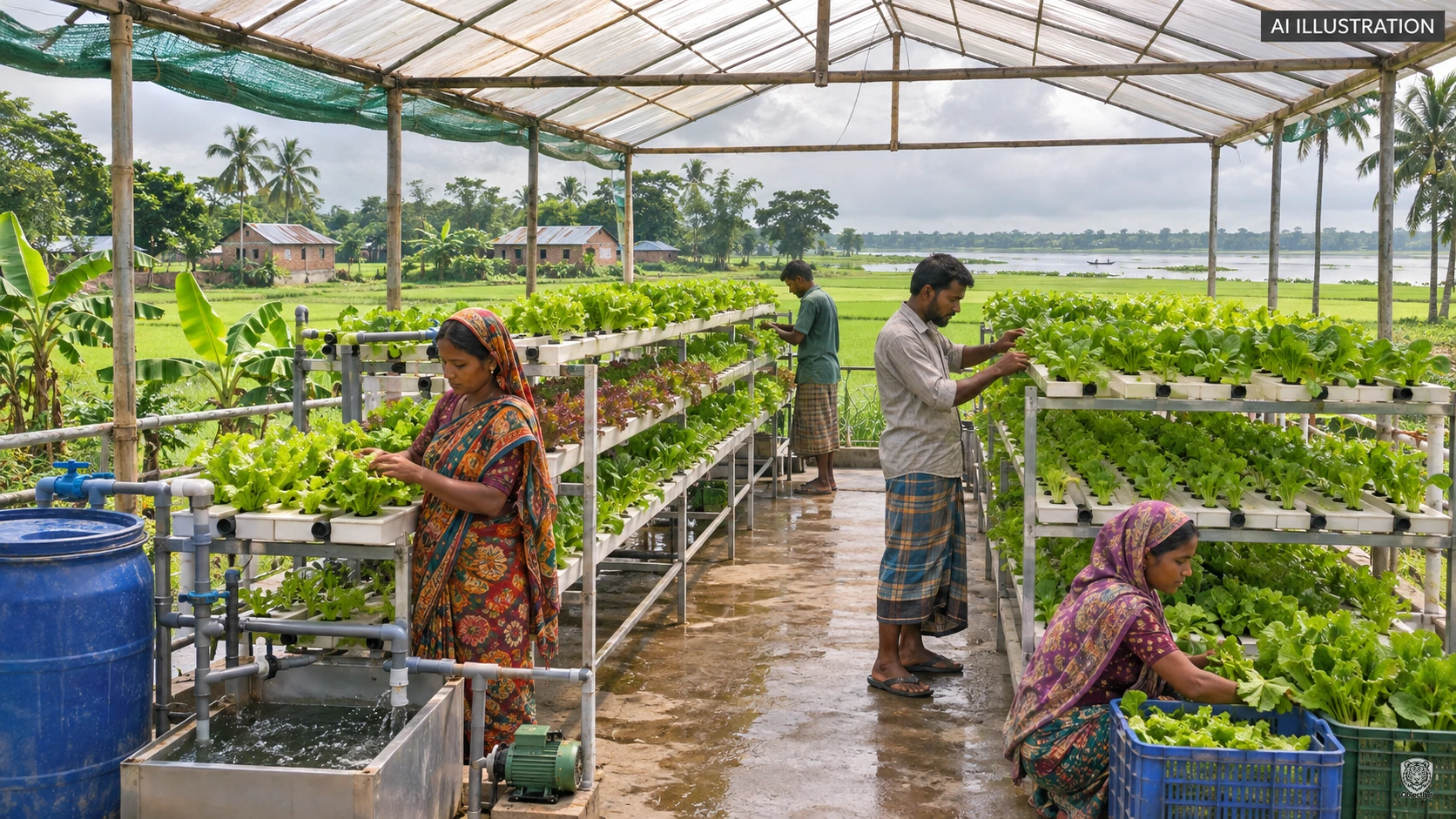
Bangladesh’s growth reflects decades of work since independence in 1971. Garment exports helped build factories, create jobs, and connect the country to global buyers. Agriculture and services support livelihoods across the country. Money sent home by Bangladeshis working abroad also helps families pay for food, education, housing, and other needs. These remittances support spending and foreign currency supplies, although they are not themselves domestic production.
However, economic size and purchasing power are different measures. A larger GDP does not prove that the average Bangladeshi can afford more than residents of every neighboring Indian state. Population, household income, local prices, and inequality all matter. Purchasing power parity, or PPP, adjusts for price differences. A fair comparison would require reliable income or consumption figures and comparable local price data for Bangladesh and each state. Bangladesh’s large economy still makes it an important regional market. Businesses nearby have reasons to seek Bangladeshi customers and trading partners. Yet families benefit only when wages and opportunities keep pace with costs. In October 2026, the World Bank warned that high inflation was reducing household purchasing power in Bangladesh.
Geography strengthens Bangladesh’s importance. West Bengal, Assam, Meghalaya, Tripura, and Mizoram directly border the country. Arunachal Pradesh, Manipur, and Nagaland belong to the wider Seven Sisters region but do not share that border. Much of the Northeast’s land traffic to the rest of India must travel around Bangladesh through the narrow Siliguri Corridor, often called the “Chicken’s Neck.” This connection provides essential access, but the detour can increase distance and expense, per Indian parliamentary report.
Chattogram, also known as Chittagong, offers a shorter route to the sea for some northeastern locations. A 2021 World Bank study illustrated the difference: goods from Agartala travelled about 1,600 km to Kolkata through the Siliguri Corridor, compared with a potential journey of about 200 kilometres to Chattogram. The study estimated that easier cross-border access could reduce transport costs to the port by around 80 percent. Those were potential savings under improved conditions, not measured savings for every shipment today, per World Bank transport study.
India and Bangladesh signed an agreement in 2018 to allow Indian cargo to pass through Chattogram and Mongla ports, followed by operating procedures in 2019. Approved connections include routes through Akhaura toward Agartala, Tamabil toward Dawki, and Sheola toward Sutarkandi. These create options for Tripura, Meghalaya, and Assam, with possible benefits farther inland. India’s foreign ministry reported that putting the agreement into operation facilitated transit cargo movements in 2023.
Bangladesh’s transport role also extends beyond seaports. In March 2026, India’s government reported that about 1,500 tonnes of steel products and slag reached Pandu in Guwahati from Kolkata through the Indo-Bangladesh inland-waterway route. This is evidence of actual transit through Bangladesh. That distinction matters. The Northeast retains routes through Indian territory, and the benefits of Bangladeshi ports vary by location, cargo, fees, and border conditions. West Bengal also has its own access to the sea through Kolkata and Haldia. Bangladesh is the only choice for providing valuable additional capacity and shorter journeys, especially for areas close to its eastern border.
Access also depends on political decisions. In September 2026, reports said Bangladesh was reviewing agreements with India, covering trade and connectivity. A review does not automatically mean cancellation, but it reminds businesses that routes across borders require lasting, practical cooperation. Companies need clear rules and dependable access before they can confidently build supply chains around a different port.
For Bangladesh, transit could generate income from port handling, trucking, storage, and related services. Warehouses and transport businesses could create jobs near ports and border crossings. For northeastern producers, cheaper and more predictable shipping could make their goods more competitive. Shorter routes may also reduce inventory costs and losses for products that spoil quickly. These gains would give businesses on both sides practical reasons to support cooperation.
Success requires more than drawing routes on a map. Ports must handle cargo efficiently, roads must support additional trucks, and customs procedures must be clear. Charges should cover public costs while keeping routes competitive. Agreements also need safeguards for safety, local communities, and the environment. Political disagreements or unpredictable restrictions can weaken the value of even the shortest route.
Bangladesh’s economic size and coastal position give it substantial influence in the region. The strongest opportunity is to turn those advantages into better living standards and dependable trade. Fair agreements, efficient infrastructure, and stable cooperation can help Bangladesh earn income while giving the Northeast more choices. That would make regional growth both more connected and more broadly shared.
References
- Committee on External Affairs. (2025, December). Future of India-Bangladesh relationship (Ninth report, Eighteenth Lok Sabha). Lok Sabha Secretariat.
- Directorate of Economics & Statistics, Government of Nagaland. (2026). Nagaland economic survey 2025–26.
- India will take necessary measures to protect interests: MEA amid Bangladesh review of bilateral pacts. (2026, September 18). The New Indian Express.
- Ministry of External Affairs, Government of India. (2024). Annual report 2023.
- Ministry of Ports, Shipping and Waterways. (2019, October 7). Shri Mansukh Mandavia says conclusion of SOP with Bangladesh on Chattogram and Mongla ports a win win situation for both countries [Press release]. Press Information Bureau.
- Ministry of Ports, Shipping and Waterways. (2026, March 24). Inland waterways power 1,500 MT high-value cargo movement to Pandu from Kolkata [Press release]. Press Information Bureau.
- Ministry of Statistics and Programme Implementation. (2026, April 17). Gross state domestic product at current prices (for 2011–12 to 2025–26); base year 2011–12 [Data set].
- Reserve Bank of India. (2025). Handbook of statistics on Indian states, 2024–25.
- Reserve Bank of India. (2026). Handbook of statistics on the Indian economy, 2025–26 (28th ed.).
- World Bank. (n.d.-a). বাংলাদেশ [Data set]. Retrieved November 4, 2026, from World Bank Open Data.
- World Bank. (n.d.-b). Metadata glossary: Bangladesh. Retrieved November 4, 2026, from DataBank.
- World Bank. (2021a, March 9). Seamless transport connectivity can create significant economic gains for Bangladesh and India [Press release].
- World Bank. (2021b, April 30). PPPs for policy making: A visual guide to using data from the ICP—Chapter 1: The size of the economy and price levels.
- World Bank. (2022). The World Bank Group in Bangladesh, fiscal years 2011–20.
- World Bank. (2026a, October 6). Bangladesh needs urgent financial, energy, and revenue reforms to restore growth, create jobs [Press release].
- World Bank. (2026b, October 25). বাংলাদেশ.